

Signs of Sewer Line Damage in Your Yard: 2026 Guide

Table of Contents
Warning Signs of Sewer Line Damage in Your Yard
Soggy Spots, Sinkholes, and Unusually Green Grass
Foul Odors, Gurgling Sounds, and Slow Drains
Sewer Camera Inspection: How Professionals Confirm the Problem
DIY vs. Professional Diagnostic Tools for Sewer Lines
Average Cost to Repair Sewer Line: What Drives the Price
Typical price ranges by repair method
What actually drives the price
Why phone quotes are unreliable
What insurance and warranties may cover
Sewer Line Repair vs Replacement: Which One Do You Need?
The three paths, and when each applies
Pipe material and expected lifespan
The decision thresholds
Trenchless vs. excavation: the real trade-off
Questions to ask before you decide
Preventative Maintenance and Insurance Coverage for Sewer Lines
Frequently Asked Questions
Last Updated: September 28, 2026
Warning Signs of Sewer Line Damage in Your Yard
A failing main sewer line rarely announces itself with one dramatic event. It leaves small clues across your lawn and inside your home, and catching them early is the difference between a targeted repair and a full excavation. Homeowners who recognize the early signs of sewer line damage in their yard can save thousands in emergency work. This guide covers the eight warning signs that matter most, how professionals confirm a diagnosis, what drives repair costs, and when repair gives way to replacement.
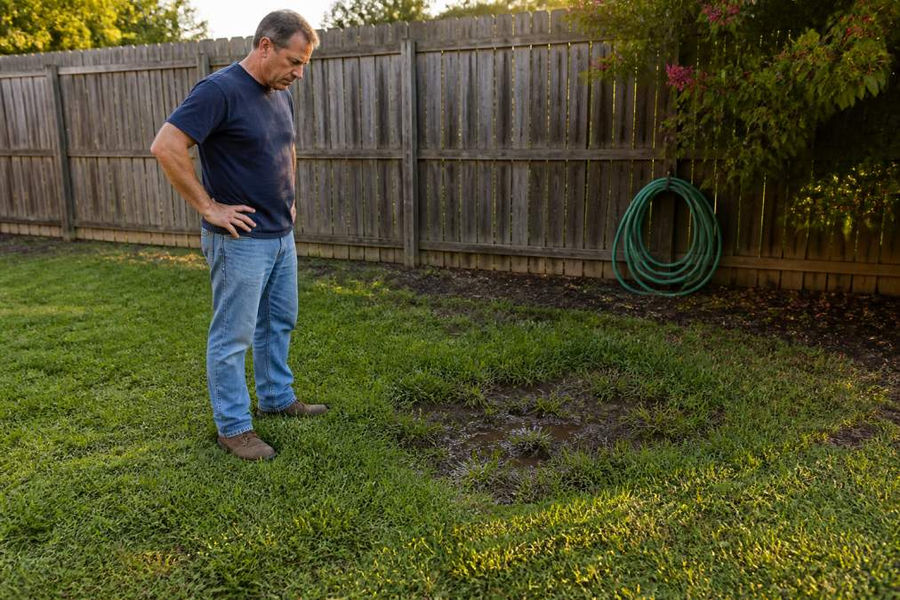
Soggy Spots, Sinkholes, and Unusually Green Grass
Soggy patches and sunken spots are often the first visible sign of a leaking or collapsed sewer lateral. When a pipe cracks or shifts, wastewater seeps into the soil, softening the ground above it. Watch for:
Soggy spots and standing water that persist long after rain stops, especially in dry weather, ground saturation from a leaking pipe, not normal drainage.
Sinkholes and ground depressions along the sewer line's path. A depression that deepens over weeks signals soil erosion and possible structural failure.
Lush or unusually green grass patches in an otherwise dry lawn. Sewage acts as a fertilizer, so a strip of bright green grass tracing your pipe's route is a classic clue.
Watch Out Never ignore a sinking depression in your yard, even a shallow one. A cavity forming over a compromised pipe can collapse under the weight of a person, a pet, or a riding mower, and it usually means the pipe beneath has already lost structural integrity.
Foul Odors, Gurgling Sounds, and Slow Drains
Foul odors, gurgling sounds, and slow drains are the indoor warning signs that pair with the outdoor ones, usually meaning sewer gas or wastewater is backing up. If your yard shows physical symptoms and your fixtures misbehave at once, the evidence is strong. Look and listen for:
Sewer gas smells near floor drains, basement cleanouts, or the yard. Hydrogen sulfide has a distinct rotten-egg odor and shouldn't be present in a sealed system.
Gurgling sounds in pipes and toilets after you run a sink or shower, air being pulled through a partial blockage or a pipe that has lost its slope.
Slow drains and recurring clogs across multiple fixtures. One slow sink is a local clog; three slow drains at once point to the main sewer line.
Pest and rodent infestations entering through a broken pipe. Rats and cockroaches exploit cracks in a sewer line as an entry route into a home.
Sewer Camera Inspection: How Professionals Confirm the Problem
A sewer camera inspection threads a waterproof, lighted camera through the main sewer line to record its interior condition in real time, the only reliable way to confirm what's wrong underground without digging. It travels from the cleanout to the municipal sewer connection, capturing video of cracks, root intrusion, offset joints, and blockages.
Affordable Comfort
DIY vs. Professional Diagnostic Tools for Sewer Lines
Homeowners can detect surface symptoms, but confirming sewer line damage requires professional diagnostic equipment. Here's how the two compare:
Approach | What It Detects | Limits |
Visual yard inspection | Soggy spots, sinkholes, green patches | Cannot see underground |
Drain snake or auger | Local clogs near an access point | Misses cracks, root intrusion, offset joints |
Sewer camera inspection | Cracks, root intrusion, blockages, pipe condition | Requires professional equipment |
Hydro-jetting (diagnostic) | Clears and reveals blockage type | Not a standalone diagnostic |
Pro Tip Before booking any repair, ask whether the price includes a camera inspection and a copy of the footage. Reputable providers build this into the diagnostic fee, and it protects you from paying for a repair that doesn't address the real problem.
Average Cost to Repair Sewer Line: What Drives the Price
Most guides stop at "it depends." Here's what actually moves the number.
Typical price ranges by repair method
Method | Typical range | Best for |
Drain snaking / augering | $100-$350 | Isolated clogs, no structural damage |
Hydro-jetting | $300-$600 | Grease, scale, and soft root masses |
Spot repair (open excavation) | $1,500-$4,000 | One localized crack or offset joint |
Pipe lining (CIPP) | $4,000-$12,000 | Cracks, joint gaps, root intrusion in otherwise sound pipe |
Pipe bursting | $6,000-$15,000 | Full replacement where the existing line can be pulled through |
Full excavation and replacement | $8,000-$25,000+ | Collapsed, misaligned, or extensively root-damaged lines |
Many contractors credit the camera inspection fee toward the repair if you authorize the work.
What actually drives the price
Depth of the line. A lateral 3 feet down is a straightforward dig. One 8 to 10 feet down requires shoring, larger equipment, and more labor hours per foot.
Length of the damaged run. Spot repairs price per location; lining and bursting price per linear foot, so a 60-foot run costs far more than a 20-foot one.
Access and surface restoration. A line under open lawn is cheapest. Under a concrete driveway, paver patio, or mature tree's root zone, expect excavation, cutting, and restoration costs that can rival the pipe work itself.
Pipe material. Clay and cast iron laterals are common in older homes and more prone to root intrusion and joint failure. PVC and HDPE are easier to repair and line.
Cause of failure. A single root intrusion is a spot repair. Offset joints, bellies, and collapsed sections often force a longer repair or replacement.
Permits and municipal coordination. Work at or near the municipal connection may require a permit and inspection. Fees vary by jurisdiction.
Emergency vs. scheduled. Weekend, holiday, and after-hours calls carry surcharges that can add 25%-50% to labor.
Why phone quotes are unreliable
A flat price quoted before anyone sees the line is a guess. Depth, access, and pipe condition can't be assessed over the phone, and the difference between a $1,800 spot repair and a $14,000 lining job often comes down to what the camera shows. The honest sequence: camera inspection first, written estimate second, work third.
Pro Tip Ask for a written estimate that itemizes the pipe work, excavation, surface restoration, and permits separately. That breakdown lets you compare bids apples-to-apples and see exactly where one contractor is cutting corners or padding the job.
What insurance and warranties may cover
Standard homeowners insurance generally excludes the sewer lateral itself and damage from gradual deterioration, root intrusion, or wear over time. It may cover sudden, accidental damage, a contractor striking the line, or a collapse that damages the insured structure. A service line endorsement or home warranty sometimes fills the lateral gap, but terms vary widely. Read your policy before you need it.
Sewer Line Repair vs Replacement: Which One Do You Need?
The camera footage settles this question. After you see it, the decision falls into one of three buckets: spot repair, trenchless rehabilitation, or full replacement.
The three paths, and when each applies
Spot repair (open excavation). Best when the camera shows a single defect, one crack, one offset joint, one root intrusion point, and the surrounding pipe is sound. A crew digs down, cuts out the damaged section, and replaces it with new pipe. The catch: if the rest of the line is old or compromised, you'll be back in a year or two for the next failure.
Cured-in-place pipe (CIPP) lining. A resin-saturated liner is inserted into the existing pipe and cured in place, forming a new pipe inside the old one. Minimal digging, usually just access pits at each end. Works for cracks, joint gaps, and root intrusion. Not suitable for fully collapsed or severely misaligned pipe.
Pipe bursting. A bursting head is pulled through the old pipe, fracturing it outward while pulling new HDPE pipe into the void. Effectively a full replacement with minimal surface disturbance.
Pipe material and expected lifespan
Pipe material is one of the strongest predictors of whether repair or replacement makes sense.
Clay tile. Common in pre-1970s homes. Joints are the weak point, roots find them, and the pipe cracks under ground movement. A clay line with multiple root intrusions is usually a replacement candidate.
Cast iron. Common in mid-century homes. Corrodes from the inside out, eventually scaling shut or cracking. Lifespan is typically 50-75 years, and many cast iron laterals are already past it.
Orangeburg. A tar-paper pipe used in some mid-century construction. It deforms and collapses and is essentially always a replacement candidate.
PVC and HDPE. Modern materials with 50-100 year lifespans. When these fail, it's usually a localized defect, making spot repair or lining viable.
The decision thresholds
A useful rule of thumb: one defect in an otherwise sound pipe means repair it. Three or more defects, widespread root intrusion, or a pipe material past its expected lifespan means replace it. If the pipe is sound but has cracks or joint gaps, lining is often the middle path, cheaper than full replacement, more durable than a spot fix.
Trenchless vs. excavation: the real trade-off
Trenchless methods cost more per linear foot than open excavation in many markets, but they save on surface restoration, no torn-up driveway, no re-sodded lawn, no rebuilt patio. For a line under finished landscaping or hardscape, trenchless often wins on total cost. Under open lawn with easy access, excavation can be cheaper and faster.
Watch Out Don't authorize a full replacement based on a phone diagnosis or a drain snake alone. A snake clears a clog but tells you nothing about pipe integrity. Insist on camera footage with depth and distance measurements before committing to any structural work.
Questions to ask before you decide
Where exactly is the defect, and how deep is it?
Is the rest of the pipe sound, or are there other defects the camera caught?
What material is the pipe, and how old is it?
Is trenchless an option for this failure, and if not, why?
What's the expected lifespan of the repair?
Does the estimate include surface restoration and permits?
A written estimate that answers these questions is what separates a real diagnosis from a sales pitch.
Preventative Maintenance and Insurance Coverage for Sewer Lines
Other preventative steps:
Schedule periodic drain cleaning before clogs become backups
Avoid flushing wipes, grease, and heavy solids that accelerate blockages
Fix slow drains early rather than waiting for a full backup
Keep a record of your line's material and location for future service calls
Address ground saturation and poor drainage that stress the pipe
Key Takeaway The two highest-return moves for any homeowner are an annual camera inspection and a written confirmation from your insurer about whether your sewer lateral is covered. Both cost little now and prevent a five-figure surprise later.
For ongoing maintenance across multiple rental units or commercial properties, Causeway Plumbing LLC offers scheduled service so recurring drain issues get addressed before they become emergencies. We're open seven days a week and maintain a dedicated service department.
Frequently Asked Questions
What are four signs that your sewer line is broken?
Four common signs of sewer line damage in your yard include: unusually lush or green grass patches over the pipe, soggy spots or standing water that won't drain, foul sewage odors near the foundation, and gurgling sounds from toilets or drains after you run water. Sinkholes or ground depressions along the sewer path are another strong indicator. If you notice two or more of these together, call a licensed plumber for a camera inspection before the problem worsens.
Is a broken sewer line covered by homeowners insurance?
Most standard homeowners insurance policies do not cover sewer line damage from normal wear, tree root intrusion, or pipe corrosion. However, some policies may cover sudden damage from a covered peril like a vehicle striking the line or a freeze event. Home warranty plans and sewer line protection riders sold by utilities often fill this gap. Check your specific policy language or ask your insurer directly, since coverage varies widely by provider and state.
What happens during a professional sewer camera inspection?
A plumber feeds a flexible camera through a sewer cleanout or access point and pushes it down the main sewer line. The camera transmits live video to a monitor, letting the technician see cracks, root intrusion, offset joints, and blockages. Most inspections take 30 to 60 minutes and include a recorded video or written report. This step confirms whether you need spot repair, trenchless repair, or full replacement before any digging starts.
Can tree roots cause sewer line damage in the yard?
Yes. Tree and shrub roots seek moisture and can enter sewer lines through tiny cracks or loose joints. Once inside, roots grow into thick masses that catch waste and cause recurring clogs. Signs include slow drains in multiple fixtures, gurgling toilets, and lush green patches over the line. Root intrusion is one of the most common causes of sewer line damage, especially in older clay or cast iron pipes common in established neighborhoods.
Get In Touch


Comments